Planning A Village Extension: Balancing Growth And Infrastructure
.webp)
Pressure on local authorities to deliver new homes in rural areas is growing. This is driven by changes to national planning policy and further reforms outlined in the National Planning Policy Framework (NPPF) 2025 consultation.
However, many village communities are highly protective of their character, so edge-of-settlement development can quickly become contentious and politically sensitive.
As a result, small developers need strong masterplanning and clear evidence that local infrastructure can cope with growth, without undermining village character or policy objectives. Village extension design plays a key role in how new housing is perceived, assessed, and ultimately accepted.
In this article, the Taylor Roberts team draws on decades of hands-on experience to share practical insights into navigating village expansion planning.
Understanding The Planning Framework For Rural Development
The NPPF sets out how rural development is assessed.
It distinguishes between villages that can support new development and more isolated locations, where tighter controls apply. This is based on access to services, transport connectivity, and a village’s role within the wider settlement hierarchy.
In practice, these criteria are applied through Local Plan policy. Settlement boundaries, spatial strategy, and infrastructure capacity then influence the scale, form, and location of village expansion.
Villages identified as more sustainable, with access to employment, schools, and public transport, are generally better placed to accommodate expansion than those with limited services.
Factors Local Planning Authorities Consider
The local plan context matters. Councils with an up-to-date plan and a proven five-year housing land supply tend to resist unallocated village extensions. If plans are under review or housing delivery is behind, LPAs may be more open to well-justified proposals.
Neighbourhood Plans can also affect whether rural development is supported or resisted, depending on local priorities and evidence.
Housing Market Needs Assessments help set out how much development villages are expected to accommodate, as well as the size, type, and mix of homes.
Site Assessment And The Role Of SHELAA
Strategic Housing and Economic Land Availability Assessments (SHELAA/SHLAA) play a key role in this process. They identify sites that are considered “deliverable” or “developable” over the Local Plan period, based on availability, suitability, and achievability.
Inclusion in a SHELAA does not grant planning permission or confirm that development will take place. However, it can strengthen the planning case by showing that the Local Planning Authority has already assessed the site as a realistic option for growth.
Bringing Village Extensions Forward
There are two main ways developers can advance village expansions.
One is through the Local Plan process. This often involves working with land promoters acting for landowners under promotion agreements. This route is usually better suited to larger edge-of-settlement sites that are difficult to progress through a standalone planning application.
The other option is a speculative planning application, which some developers use where housing supply is tight and policy allows more flexibility.
The Appeal Landscape: When NPPF Overrides Local Opposition
When a Local Planning Authority cannot show a five-year housing land supply, national policy carries greater weight in decision-making.
In these circumstances, planning permission is more likely - based on the presumption in favour of sustainable development - unless the impacts clearly outweigh the benefits when applying the tilted balance.
At appeal, the focus shifts to whether a proposal is acceptable in planning terms, rather than whether it reflects local preference.
Inspectors often support well-designed village extensions even where there is strong local opposition or where an emerging or out-of-date Local Plan suggests a different outcome.
When assessing applications, officers consider community objections, but they must relate to material planning issues and be backed by evidence. Emotive, speculative, or unsupported concerns are given little weight.
For developers, success at appeal depends on clear evidence that NPPF requirements are met. This includes settlement sustainability, acceptable landscape and heritage impact, safe access, and deliverable infrastructure, alongside a proportionate response to local concerns.
Site Appraisal: Identifying Key Constraints
A comprehensive early site appraisal helps establish whether a village expansion is realistic and what form it could take, before time and cost are committed to design.
Sustainability And Connectivity
Proximity to schools, shops, bus routes, and safe walking connections is a key factor in deciding whether it can support a new housing scheme. Sites that connect well with the existing village are usually easier to justify than those that depend heavily on car use.
Existing Growth And Cumulative Impact
LPAs also consider what has already been approved or allocated. Other village extensions, committed sites, and the combined impact of development can affect whether further growth is acceptable, even if a site works well on its own.
Physical Constraints And Infrastructure
Landscape impact, access options, and utilities capacity are often decisive. Poor visibility, limited access points, or constrained water, drainage, or power capacity can significantly limit what can be delivered or rule a scheme out altogether.
Flood Risk
Flood zones and surface-water risk affect which parts of a site can be built on and how the layout needs to work. In some cases, flood risk can make a site unacceptable or significantly reduce the usable area.
Ecology And Biodiversity Net Gain
Ecology constraints and Biodiversity Net Gain requirements identify protected habitats, buffer zones, and opportunities to improve biodiversity.
In most cases, schemes must deliver at least a 10% net gain, measured against the site’s baseline. This can be achieved on site or, where needed, through off-site credits.
Masterplanning A Village Extension
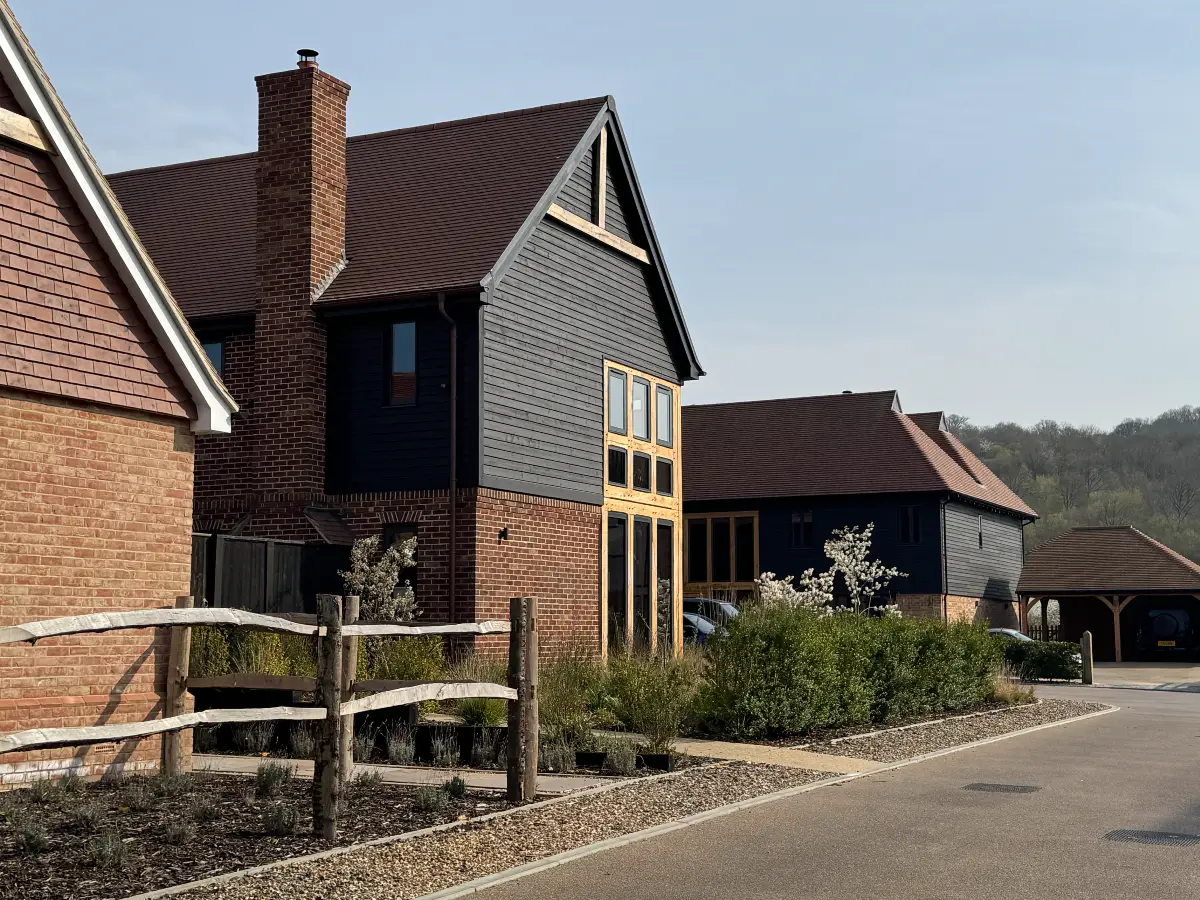
A successful village expansion is planned as a natural edge to the settlement, rather than as an isolated housing estate. The aim is to create a place that connects with the village, follows clear placemaking principles, and adds to the quality of the built environment rather than competing with it.
The design should follow these principles:
- Establish a clear spatial structure early, aligning landscape, movement routes, and built form to support sustainable growth objectives
- Provide strong connections, including pedestrian routes, green corridors, and logical links to existing streets and facilities
- Respond to relevant design guidance, including local design codes, the National Design Guide, AONB Management Plans, and character assessments
- Use parish and village design statements as evidence of local character and community expectations
- Consider phasing to align housing delivery with infrastructure provision and avoiding impacts on traffic, services, or landscape quality.
We explore masterplanning in more detail in a separate article.
Infrastructure Planning: The Core Of A Sustainable Scheme
LPAs increasingly expect technical evidence to be considered early, even at the outline stage, to show that growth can be supported without placing too much pressure on existing services.
Engaging early with highways authorities, Lead Local Flood Authorities, utility providers, and relevant health bodies helps reduce the risk of objections.
Transport
Transport planning focuses on how new development connects to the village and wider network. Key considerations include:
- Safe pedestrian routes and footpath links
- Cycle connections to local services
- Junction improvements and visibility
- Access to bus routes and public transport.
Drainage
Drainage strategies are closely scrutinised. LPAs expect:
- A clear surface-water strategy
- Use of Sustainable Drainage Systems (SuDS)
- Attenuation measures to manage run-off and flood risk.
Utilities
Early engagement with utility providers helps demonstrate that capacity exists, or can be delivered, to support new development. This includes water, foul drainage, electricity, and telecommunications.
Social Infrastructure
Village extensions must also consider the impact on local services, including:
- School capacity
- GP and healthcare provision
- Facilities to support an ageing population
- Community and recreational facilities.
Contributions and Viability
Developers need to understand what contributions are likely to be required. Some LPAs use a fixed Community Infrastructure Levy (CIL), while others rely on site-specific contributions agreed through planning obligations.
Understanding Local Needs and Engaging With Community Stakeholders
Early engagement with community stakeholders helps identify the issues that matter most to village communities and provides a basis for informed discussion. LPAs and inspectors place weight on schemes that deliver wider public benefit, not just housing numbers.
Common areas of focus include:
- Traffic levels, road safety, and calming measures
- Footpath links, walking routes, and connectivity
- Community spaces and shared facilities
- Landscape, ecology, and biodiversity improvements.
Approaching Parish Councils and Residents
Early engagement is most effective when it stays informal, is proportionate to the scheme, and focuses on principles rather than set designs.
This may include meetings with the parish council, small group discussions, or a simple public information event to explain the site context, planning position, and key constraints before finalising detailed layout.
It is also important to explain the main benefits of the scheme, such as housing mix, any affordable provision, open space, and safer pedestrian routes.
Managing Opposition
Opposition is common in villages, where people are often cautious about change.
Consultations frequently bring to light misunderstandings about planning policy or what a proposal would actually deliver. Addressing these calmly, with clear evidence and simple explanations, helps keep the discussion focused on material planning issues rather than opinion.
Section 106 Obligations and Viability
LPAs use Section 106 obligations to secure the infrastructure and mitigation needed to make proposals acceptable.
What Section 106 Typically Covers
- Affordable housing
- Highways and access works
- Open space and play areas
- Ecology mitigation and Biodiversity Net Gain measures
- Contributions towards education and healthcare.
Viability
Village schemes often require a higher upfront investment, especially when new infrastructure is needed, such as school expansions or junction upgrades. For this reason, viability needs to be clearly set out.
Where viability issues are clearly shown, LPAs may be willing to reduce or phase obligations to support delivery.
Section 106 vs CIL
In areas where the Community Infrastructure Levy applies, Section 106 obligations are more limited and cannot cover items already funded through CIL. Understanding how the two work together is important when assessing costs and viability at an early stage.
Delivering a Successful Village Extension
Successful village expansion planning balances housing growth with good placemaking, proportionate infrastructure, and a clear response to rural character and local needs.
Schemes are more likely to succeed where design is planning-led, and infrastructure is considered early, supported by clear reasoning and alignment with national policy, particularly where Local Plans are ageing or housing supply is weak.
For developers, understanding SHLAA, the NPPF, the appeal process, infrastructure requirements, and community pressures is essential when advancing village extension proposals.
A strong planning strategy, supported by experienced professional advice, improves the chances of securing consent.
At Taylor Roberts, we support developers across Kent and the South East with clear, planning-led advice on village expansions and rural development. From early site appraisals through to full planning submissions and detailed design, we guide schemes from concept to consent.
At Taylor Roberts, we have over 20 years’ experience advising on village extensions and rural housing schemes, with offices in Canterbury and Tunbridge Wells. Call 01227 457 545 or email enquiries@taylorroberts.co.uk to discuss your site or proposal.
Contact our team today for expert property advice - book now for free.

Architectural Insights
Insights, updates and ideas from the studio - here’s what we’ve been writing about lately.